

Protein structure: the key to a cure for Parkinson’s Disease?
Premier prix du concours de blogs 2025, par Julian Wagner.
25 juillet 2025
Reading this title, you might be wondering: “What on earth do proteins have to do with Parkinson’s Disease”? After all, Parkinson’s is usually associated with tremors and stiffness, although it’s actually a brain disease where certain brain cells (neurons) die off. Proteins, on the other hand, probably make you think of protein shakes, bars or gym routines and if you’ve ever checked a nutrition label, you’ve seen ‘protein’ listed. However, this is not a guide to becoming the next Arnold Schwarzenegger. Instead, let’s talk about how understanding the shape of a certain protein could help develop a cure for Parkinson’s Disease.
To understand this better, we must first rethink the idea that proteins are just something in our diet. It is more accurate to think of them as tiny biological machines. And when I say tiny, I mean unbelievably small – about 15 million times smaller than a tennis ball! Like machines, proteins carry out a huge range of tasks, ranging from digesting food to fighting off infections. Remember when everyone was talking about coronavirus antibodies? Those are proteins, too! Even right now, as you read this, there are proteins in your brain making it possible for you to process and understand these words. In short, proteins do much more than help build muscle – they are essential to almost everything happening in an organism and beyond, including industry and even our household.
Scientifically speaking, a protein is a biological macromolecule made up of an amino acid chain. It helps to think of proteins as Lego® sets. This might sound odd at first, but the analogy works surprisingly well. Proteins are built from basic building blocks called amino acids – like a Lego® set is built from individual Lego® bricks. Like Lego® bricks, amino acids share a common structure, but come in different sizes, shapes and have unique properties. When linked together, they form long chains (polymers) – imagine assembling Lego® bricks in a specific order. Just as building a castle or a spaceship requires different arrangements of bricks, the sequence of amino acids then determines the final 3D shape (structure) of the protein (Figure 1). The process of acquiring the 3D structure is called protein folding. The structure then dictates the protein’s function. Although we can’t see it with the naked eye, this structure is what allows the protein to do its job!
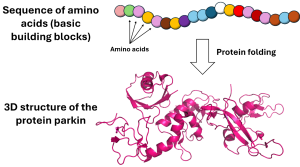
A protein is composed of amino acids and the order (sequence) of these amino acids determines its 3D structure that is acquired through the process of protein folding. A protein‘s function is determined by its structure. The parkin structure was taken from the Protein Data Bank (PDB ID: 4K95), Trempe at al., Science (2013).
Now imagine what happens when a protein’s structure is wrong: It can’t function properly, leading to problems. In fact, dysfunctional proteins, especially those with altered structures, are linked to a variety of diseases, including cancer, immune disorders or neurodegenerative diseases, which brings us back to Parkinson’s. Here’s where the protein parkin steps in because – surprise, surprise – it’s a key player in the disease. The loss of parkin function due to structural defects causes a hereditary form of Parkinson’s, marked by an early onset of the disease. Mitochondria, often described as “the powerhouse of the cell” in biology textbooks, are essential for our cells’ energy supply. However, when they are damaged, they need to be removed and recycled to prevent further damage and keep our cells healthy. Parkin helps manage this process of mitochondrial quality control by tagging defective mitochondria for degradation (Figure 2) [1]. This tagging process is called ubiquitination. However, when parkin doesn’t work properly, this cleanup process fails, leading to cellular damage and disease.
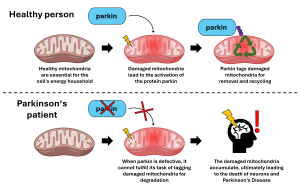
In a healthy person, parkin will be activated when damaged mitochondria are detected. Parkin will then tag them (ubiquitination, shown here as purple circles) for removal and recycling. This requires parkin to have a specific structure. However, in Parkinson‘s Disease patients where parkin is defect, this process is disturbed. This ultimately leads to loss of neurons in specific areas of the brain and Parkinson‘s.
Figure partly created with BioRender (BioRender.com), based on Gehring & Trempe, Journal of Molecular Biology (2023) and Narendra & Youle, Nature Cell Biology (2024).
All currently available treatments are targeting the symptoms of Parkinson’s instead of its root causes [2]. This is why scientists are working on finding ways to repair parkin and restore its original function with the hope of curing Parkinson’s – at least for a subset of patients [3]. While hereditary defects in parkin represent a minority of cases, evidence suggests that parkin’s role in mitochondrial quality control is crucial in other forms of Parkinson’s as well. Understanding parkin’s structure, investigating the impact of structural changes occurring in patients, and the mechanism at work is key to developing new treatment options. Unfortunately, designing drugs to repair parkin remains a long, expensive and complex process. So, while at first glance studying a protein’s structure might seem irrelevant and basic research often feels distant from real-world problems, it truly is the foundation of medical breakthroughs. This is why government funding for fundamental science is so critical – and why recent cuts to research budgets have caused widespread concern among researchers [4]. Scientific breakthroughs rarely happen overnight, but despite these challenges, we believe that our research can make a difference. One day, it might even help cure Parkinson’s.

Julian Wagner
Julian is a graduate student in Biochemistry at McGill University and at CRBS. His laboratory work focuses on structural biology and protein structure, but he is also passionate about teaching, outreach and science communication. Outside the lab, you can find him at concerts, swimming, reading or playing tabletop games.
References:
- Scientific review on the role of parkin in mitochondrial quality control: Narendra, D. P., & Youle, R. J. (2024). The role of PINK1-Parkin in mitochondrial quality control. Nature cell biology, 26(10), 1639–1651. https://doi.org/10.1038/s41556-024-01513-9
- Helpful resource on Parkinson’s Disease medication (Parkinson Canada) in lay language: https://parkinson.ca/wp-content/uploads/2025/01/Parkinsons-Medications-what-you-need-to-know.pdf (accessed: April 14, 2025)
- Short scientific review on a new compound that is able to restore some defective parkin variants: Sauvé, V., & Gehring, K. (2025). A molecular glue for PRKN/parkin. Autophagy, 21(3), 689–690. https://doi.org/10.1080/15548627.2024.2443232
- News article covering protests in response to science budget cuts: https://apnews.com/article/science-doctors-cuts-budget-trump-health-climate-cead2742a686b3dbc2fe4b1294939454 (accessed: April 15, 2025)
Plus d'articles
Établissements membres de PROTEO













Le regroupement québécois de recherche sur la fonction, l'ingénierie et les applications des protéines.

PROTEO est un regroupement stratégique subventionné par le FRQ
PROTEO - Tous Droits Réservés. | Site web créé avec par Sudo agence web