

Proteins as biomarkers: The heroes behind the scenes of diagnosis and treatment
Third prize in the 2025 blog contest, by Vrinda Nair.
July 25, 2025
Our body is full of hidden gems like secret agents, party planners, and emergency alarms, all working behind the scenes to keep us healthy. One of the most important “hidden forces” inside our body is proteins—and some of them act as biomarkers, which are like little messengers that signal what’s happening inside us. Protein biomarkers can reveal early signs of diseases which can help doctors monitor your health and even guide you to get a better treatment(s) [1,2]. In this blog, we’ll explore the fascinating world of protein biomarkers by looking at how they serve as reliable biomarkers for disease diagnosis and as a target for developing effective therapies.
What are protein biomarkers?
Protein biomarkers are like little superheroes inside our bodies. The biomarkers are biological indicators—that signal something about the state of our health or disease in our body. In that way, the biomarkers can reveal the presence of diseases like cancer, heart disease, and neurodegenerative conditions, often before symptoms appear [1]. For example, some proteins are released when the body’s tissues are damaged, while others are altered by the presence of infection or cancer [3]. Doctors can gain valuable insights into a patient’s health by detecting specific proteins in blood, urine, or tissue samples which act as biomarkers.

Proteins as diagnostic tools: Early detection saves lives
Let’s dive into how proteins serve as early warning signals in the body. A few examples of how proteins act as the body’s detective squad—
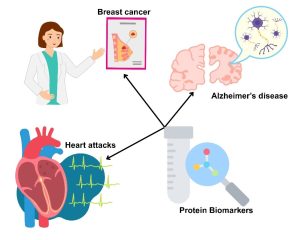
1. The overenthusiastic party planner: HER2 (and breast cancer)
In some breast cancers, HER2 (a protein) decides to throw a wild, out-of-control party in your cells. It invites way too many guests (in this case, the cancer cells) and encourages them to grow and divide uncontrollably. HER2 is like the friend who goes overboard with the guest list, making the party more chaotic than it should be. So, in this case, targeted treatments (like Herceptin) can stop HER2 from overstimulating cancer cells [4], much like a good event coordinator stepping in to prevent a disaster.
2. The emergency alarm: Troponin (and heart attacks)
If your heart ever faces a crisis—like during a heart attack—your body has a built-in alarm system. Enter troponin, a protein that sounds the alarm when the heart muscle is damaged. When heart cells break down, troponin is released into the blood, giving doctors the heads-up that something’s wrong. Think of it as a security alarm in your house—if the alarm goes off, you know there’s trouble, and you need to act fast to prevent damage. In the same way, when troponin levels spike in your blood [5], doctors know your heart is in trouble and can rush to intervene.
3. The party crasher: Amyloid beta (and Alzheimer’s disease)
Your brain is like a grand party, where everything is in sync and communication flows smoothly between the cells. But every once in a while, there’s that one party crasher—amyloid beta. This protein forms sticky plaques in the brain, disrupting the communication between neurons [6]. The result— Alzheimer’s disease. If doctors detect amyloid beta early, they can take steps to slow the progression of Alzheimer’s before it gets too out of hand.
Proteins as targets for therapy development
There is no doubt that proteins are vital for diagnosis, but they also serve as powerful targets for therapy development. When doctors know which protein(s) are involved in a disease, they can design treatments to specifically target those proteins which can improve the effectiveness of therapies (while minimizing side effects). For example—by focusing on a specific protein, the therapy helps slow down or even stop cancer growth, offering a much more targeted and effective treatment than traditional chemotherapy. In addition to cancer, proteins are also a key target in treating other conditions like autoimmune diseases, neurological disorders, and infectious diseases. By understanding the role of proteins in diseases, researchers can develop targeted therapies that offer better outcomes with fewer side effects.
Conclusion
Just like how a party planner, an emergency alarm, or a party crasher can change the course of an event, these protein biomarkers have the power to change the course of your health. As science and technology continue to evolve—proteins will remain at the forefront of medical improvements, unlocking new pathways for better diagnosis, and treatment for improved health outcomes. So, the next time you hear about a protein biomarker, remember: it’s not just a fancy scientific term—it’s a crucial part of your body’s superhero team.

Vrinda Nair
Vrinda Nair is a doctoral candidate in physics whose proejct focuses on drug design of small molecules by implementing computational tools and aims to find new antibiotics. Her doctoral research is funded by the NSERC, CRC, Mitacs, and Concordia. She also works as an site coordinator for Let’s Talk Science.
References:
1. Murphy, G. (2025) What are protein biomarkers? Nautilus Biotechnology. Available at: https://www.nautilus.bio/blog/what-are-protein-biomarkers/.
2. Stastna M, Van Eyk JE. Secreted proteins as a fundamental source for biomarker discovery. Proteomics. 2012 Feb;12(4-5):722-35. doi: 10.1002/pmic.201100346. Epub 2012 Jan 19. PMID: 22247067; PMCID: PMC3517109.
3. Barker AD, Alba MM, Mallick P, Agus DB, Lee JSH. An Inflection Point in Cancer Protein Biomarkers: What was and What’s Next. Mol Cell Proteomics. 2023 Jul;22(7):100569. doi: 10.1016/j.mcpro.2023.100569. Epub 2023 May 16. PMID: 37196763; PMCID: PMC10388583.
4. Gajria D, Chandarlapaty S. HER2-amplified breast cancer: mechanisms of trastuzumab resistance and novel targeted therapies. Expert Rev Anticancer Ther. 2011 Feb;11(2):263-75. doi: 10.1586/era.10.226. PMID: 21342044; PMCID: PMC3092522.
5. Mehta, P., McMillen, M. and Sachdev, P. (2023) Cardiac troponin test: A test that detects a heart attack, WebMD. Available at: https://www.webmd.com/heart-disease/what-is-cardiac-troponin-test.
6. What happens to the brain in Alzheimer’s disease? (2024) | National Institute on Aging. Available at: https://www.nia.nih.gov/health/alzheimers-causes-and-risk-factors/what-happens-brain-alzheimers-disease.
More posts

PROTEO member institutions

















The Quebec Network for Research on Protein Function, Engineering, and Applications

PROTEO is supported by the FRQ
PROTEO - All Rights Reserved. | Site web créé avec par Sudo agence web