

COOLAIR: How RNA Shape Helps Plants Flower at the Right Time
Second prize in the 2026 blog contest, by Amélie Allard.
April 24, 2026
From the age of twenty until her death at ninety‑six in 2023, an English woman, Jean Combes, noted the date of first bud opening in four tree species every spring [1]. Her 76 years of records, combined with more than 400,000 citizen observations across 400 plant species, enabled a Cambridge research team to show that, due to climate change, plants in England now flower roughly a month earlier than they did before 1986 [2].
It might look like a tiny, forgettable detail – the day the tree behind your house opens its first buds – but nature works like a finely tuned orchestra. When one musician comes in too early or too late, the whole piece falls apart. Flowering time is no different. Plants must bloom when pollinators are active, insects hatch, birds need food, and frost risk has passed. When this choreography slips out of sync, the consequences ripple through ecosystems, a phenomenon known as ecological mismatch [3].
The Molecular Choreography Behind Flowering
Since timing is so critical, plants need to know when to flower. How do they do that? They cannot keep a calendar, but they rely on environmental signals – especially temperature and day length – to activate the processes that lead to flowering.
Inside the plant, these cues become a complex molecular dialogue to determine when the timing is right. This dialogue involves many actors, including proteins: molecules transcribed from DNA into RNA before being assembled into amino‑acid chains. They then fold into functional shapes that carry out many roles.
For flowering, two of these proteins are especially important:
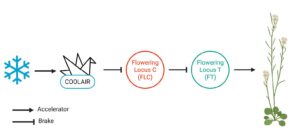
- FLOWERING LOCUS C (FLC) is a brake that prevents flowering.
- FLOWERING LOCUS T (FT) is an accelerator that signals when it is time to bloom.
This system, while very complex in nature, is essentially a molecular version of “When the cat’s away, the mice will play.” FLC is the cat: once its activity drops, FT – the mice – can be on the move. But proteins aren’t the only voices in this story. RNA molecules – nucleic‑acid strands best known as intermediates between DNA and protein – also influence when the cat quiets down. One of these, called COOLAIR, helps modulate FLC’s activity. Let’s see how.
The Winter Movement: Vernalization and COOLAIR
To understand COOLAIR’s role, we first need to look at how the FLC brake is lifted. It doesn’t happen instantly; the cat doesn’t slip out the door suddenly. It is removed gradually over weeks of winter, thanks to a process called vernalization. Vernalization is the plant’s requirement for a prolonged period of cold to unlock the flowering program: a way of confirming that enough winter has passed. Since the break lifts slowly, the plant isn’t fooled by a brief return of mild weather in the middle of winter. Quite smart, isn’t it?
And this is where COOLAIR comes in. Vernalization sets off a series of molecular adjustments that accumulate over weeks of cold, including the production of an RNA molecule called COOLAIR, to help register that winter is underway [4]. While, many RNA molecules act as protein-coding messages, telling the cell which proteins to make, COOLAIR is a non‑coding RNA, which doesn’t make proteins at all. For years, these non-coding molecules were dismissed – but we now know they can play key regulatory roles. In COOLAIR’s case, that includes helping silence the FLC gene [5, 6].
The Fold Is the Instruction
Knowing that COOLAIR helps regulate FLC is one thing – understanding how it does it is another. Recent advances in RNA‑analysis techniques reveal that it involves the RNA structure itself.
Like origami, RNA molecules twist and bend into intricate shapes that determine how they interact with other molecules. What researchers have uncovered is striking: in response to sustained cold, COOLAIR folds into specific structures that allow it to bind near the FLC gene and gradually silence it [7].
COOLAIR is only one example: it’s increasingly clear that RNA molecules across the cell carry hidden layers of information in their shapes, and the more closely we examine them, the more unexpected instructions we are likely to find. It’s an exciting new field, with many mechanisms still to uncover.
COOLAIR is the plant’s tiny archivist of winter – folding, refolding, and keeping count until spring can safely begin. When Jean Combes watched the trees outside her door, she revealed a world in motion: COOLAIR reveals part of the machinery beneath that motion. Both remind us that even the smallest observations can help us understand how our climate is changing, and how organisms are trying to adapt.

Amélie Allard
Amélie Allard is a master’s student in biochemistry in the laboratory of Prof. Zoé Joly‑Lopez at UQAM. Her research focuses on how RNA structures change in response to high‑temperature stress in rice, with the goal of making plants more resilient to climate change.
References:
[1] Combes J. Jean Combes obituary. The Guardian. 2023 Sep 24. Available from: https://www.theguardian.com/environment/2023/sep/24/jean-combes-obituary
[2] Büntgen, U., Piermattei, A., Krusic, P. J., Esper, J., Sparks, T., & Crivellaro, A. (2022). Plants in the UK flower a month earlier under recent warming. Proceedings of the Royal Society B, 289(1968), 20212456.
[3] Memmott, J., Craze, P. G., Waser, N. M., & Price, M. V. (2007). Global warming and the disruption of plant–pollinator interactions. Ecology letters, 10(8), 710-717.
[4] Zhao, Y., Zhu, P., Hepworth, J., Bloomer, R., Antoniou-Kourounioti, R. L., Doughty, J., … & Dean, C. (2021). Natural temperature fluctuations promote COOLAIR regulation of FLC. Genes & Development, 35(11-12), 888-898.
[5] Csorba, T., Questa, J. I., Sun, Q., & Dean, C. (2014). Antisense COOLAIR mediates the coordinated 4 switching of chromatin states at FLC during vernalization. Proceedings of the National Academy of Sciences, 111(45), 16160-16165.
[6] Whittaker, C., & Dean, C. (2017). The FLC locus: a platform for discoveries in epigenetics and adaptation. Annual review of cell and developmental biology, 33, 555-575.
[7] Yang, M., Zhu, P., Cheema, J., Bloomer, R., Mikulski, P., Liu, Q., … & Ding, Y. (2022). In vivo single-molecule analysis reveals COOLAIR RNA structural diversity. Nature, 609(7926), 394-399.
More posts

PROTEO member institutions

















The Quebec Network for Research on Protein Function, Engineering, and Applications

PROTEO is supported by the FRQ
PROTEO - All Rights Reserved. | Site web créé avec par Sudo agence web