

Webinar – Marie-ève Picard, Ph.D., Wednesday, October 28, at 12:15 p.m.
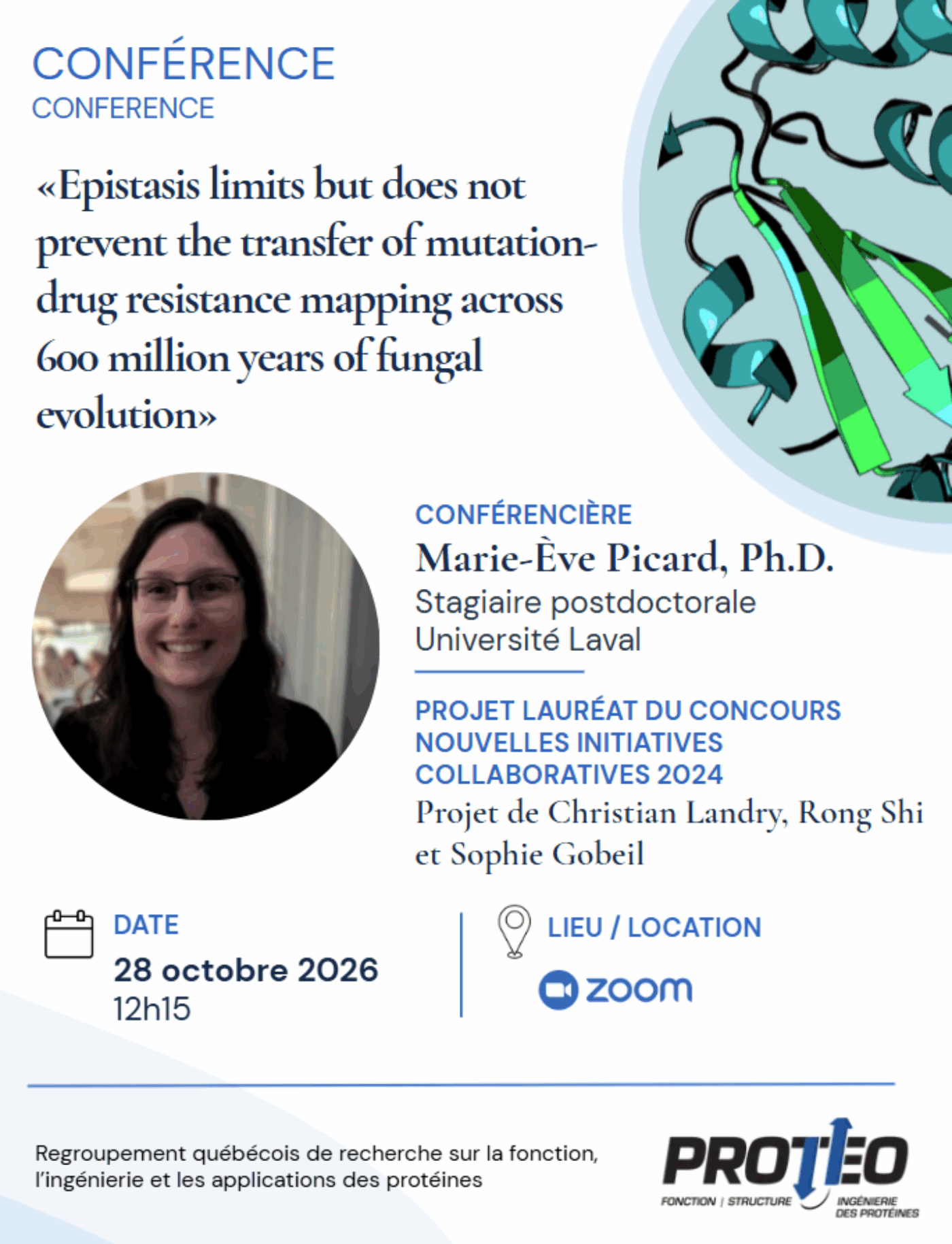
PROTEO is pleased to launch a new monthly webinar series highlighting projects awarded funding through the 2024 New Collaborative Initiatives Grant Competition. To launch this series, we are pleased to invite you to a presentation by Marie-Ève Picard, Ph.D., postdoctoral fellow at Université Laval, on Wednesday, October 28, at 12:15 p.m. The presentation will focus on one of the winning projects, led by Christian Landry, Rong Shi, and Sophie Gobeil.
Webinar link: https://uqam.zoom.us/j/85302387629
“Epistasis limits but does not prevent the transfer of mutation-drug resistance mapping across 600 million years of fungal evolution”
Whether different pathogens acquire resistance to antimicrobials through the same mutations is a major question in evolution and microbiology. Most antifungal drugs are used to treat infections caused by multiple fungal species, many of which have diverged for millions of years. If the evolution of resistance was to converge onto the same set of mutations across species, knowing the mechanism of resistance in one would allow us to predict and track it in others. The extent of this convergence remains unknown due to the lack of systematic data on resistance mutations. Here, we quantify the conservation of resistance mutations in the cytosine deaminase (CD), a protein responsible for resistance to flucytosine, one of the oldest antifungal drugs. By comparing the crystal structures of this enzyme through 600 My of evolution, we show that the CD structure is highly conserved. We compared the full CD mutational resistance spectrum of resistance from an ascomycete and a basidiomycete. We found that resistance mutations in one ortholog can be used to predict resistance in the other at a high level of accuracy. However, because of epistasis, around 10% of mutations have distinct effects in the two orthologs, which imposes an upper limit to the transferability of the knowledge of resistance mutations from one species to another. Using biochemical assays and by structural characterization of several mutants, we identify distinct mechanisms of epistasis, one important being that the local physiochemical environment of some position has evolved in a way that makes the same substitutions destabilizing or entirely inactivating in an ortholog-specific manner. Our results show that resistance mutations can be conserved in fungi across hundreds of millions of years of evolution but that epistasis eventually limits the accuracy of these predictions.
Upcoming webinar schedule :
- November 18: Collaborative project by Nicolas Bisson (ULaval) and Steve Jean (UdeS)
- December 9: Collaborative project by Denis Leclerc (ULaval) and Steve Bourgault (UQAM)
- January 20: Collaborative project by Joshua Cloutier-Beaupré (CNETE) and Sylvain Moineau (ULaval)
- February 17: Collaborative project by Daniela Quaglia (UQAM), Steve Bourgault (UQAM), and Habib Horchani (Cégep de Rivière-du-Loup)
- March 17: Collaborative project by Denis Giguère and Éric Biron (ULaval)
- April 14: Collaborative project by Steve Shih and David Kwan (Concordia)
We hope to see many of you there!
News and events


PROTEO member institutions

















The Quebec Network for Research on Protein Function, Engineering, and Applications

PROTEO is supported by the FRQ
PROTEO - All Rights Reserved. | Site web créé avec par Sudo agence web